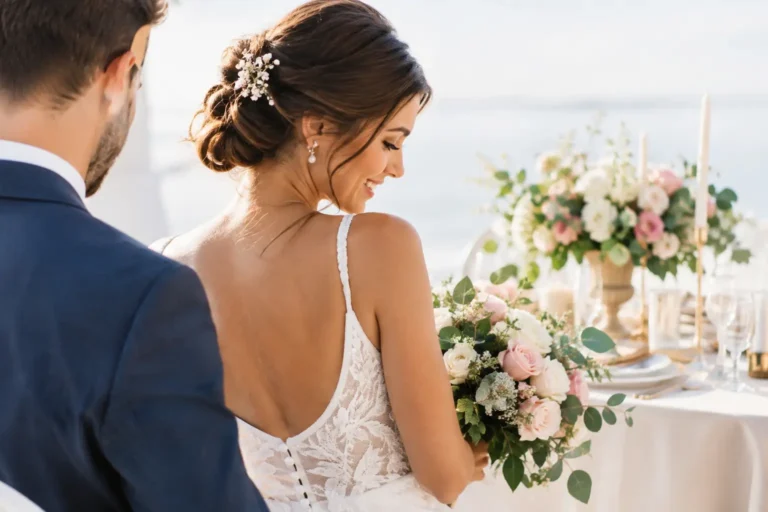
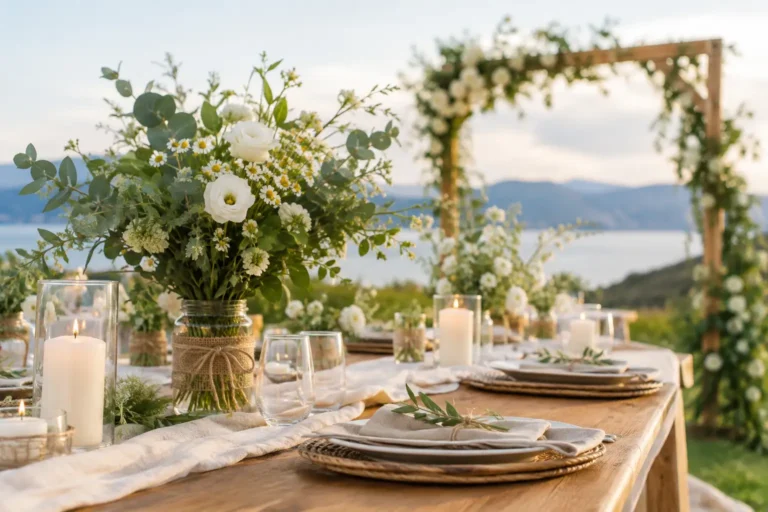
The moment you step back into the daylight as newlyweds deserves more than a hurried handful of paper shapes. Sustainable wedding confetti can create that luminous, cinematic movement around you while respecting the garden, courtyard, beach or historic setting that made you fall in love with your venue in the first place. The secret is choosing a material that belongs naturally within the atmosphere you are creating.
For me, confetti is not a throwaway detail. It is part of the visual rhythm of the day: a small, joyful gesture that catches light, frames photographs and draws your guests together for one uninhibited moment. With a little thought, it can feel as refined as your florals, fashion and tablescape.
Sustainable wedding confetti begins with the setting
Before falling for a particular colour palette, ask what your venue will allow. Many churches, stately homes, city venues and coastal locations have specific rules around confetti, and some permit only natural petals. This is not simply a matter of tidiness. Confetti can settle in delicate planting, public spaces and waterways, while a venue team may be responsible for clearing it after the celebration.
A responsible choice is therefore one that works with both the place and the practicalities. Natural petals are often welcomed because they break down gently, but even biodegradable materials may be restricted if they create a cleaning burden or disrupt the landscape. Always ask your coordinator whether confetti is permitted, where it may be thrown and whether the venue supplies approved options.
Timing matters too. A rain shower can turn paper confetti into a sticky layer on stone steps, while dried petals may lose some of their lift on a still, humid day. If you are marrying abroad, local regulations and seasonal availability can shape the decision. Let the setting lead, rather than treating sustainability as an aesthetic compromise added at the end.
The materials that feel beautiful in motion
The most elegant sustainable choices tend to have a soft, organic quality. They move with air rather than falling in heavy clumps, and they photograph with a gentle sense of abundance.
Dried flower petals
Dried petals are the natural choice for a romantic garden wedding, a countryside celebration or an old-world European courtyard. Delphinium, cornflower, larkspur, calendula and rose petals offer delicate shapes and nuanced colour. They are light enough to flutter beautifully, and their imperfect variation gives photographs more depth than uniformly cut pieces ever could.
Choose petals in tones that complement your wedding rather than matching every detail precisely. A gathering of ivory, blush, faded apricot and soft blue feels painterly beside cream silk and green foliage. For a more modern celebration, consider a restrained blend of all-white petals or a rich, autumnal mix of terracotta, burgundy and muted gold.
There is one trade-off: dried petals are usually more expensive than standard paper confetti, particularly when you need enough for every guest. They are also fragile, so keep them in a cool, dry place and distribute them shortly before the ceremony exit.
Fresh petals and leaves
Fresh rose petals have a generous, luxurious presence, particularly for an intimate ceremony with a shorter guest list. They are ideal if the visual direction is abundant, floral and sensorial. However, they can mark pale fabrics when crushed underfoot and may become slippery on smooth surfaces. They are best scattered lightly, not poured by the handful.
For a more sculptural look, consider clean, pesticide-free leaves from your florist’s own sourcing. Olive leaves, herbs and small foliage elements can be beautiful in a Mediterranean setting, although they will not float in the same way as petals. This option is particularly effective for a few purposeful photographs rather than a full guest toss.
Biodegradable paper confetti
Truly biodegradable paper confetti can suit contemporary city weddings, joyful marquee receptions and celebrations where you want stronger colour or crisp graphic shapes. Look for uncoated, dye-safe material that is explicitly approved by your venue, rather than assuming that a biodegradable label makes it appropriate everywhere.
Paper has a slightly more graphic fall than petals, which can be wonderful for editorial imagery. Yet it rarely feels as effortless in a formal garden or protected landscape, and it may cling to damp paving. If the setting is sensitive, petals remain the more considerate choice.
Create a confetti moment, not a confetti problem
How you present the confetti is as important as what it is made from. Avoid placing large bowls at the ceremony exit and hoping for the best. Guests tend to take too much, throw too early, or forget the moment altogether.
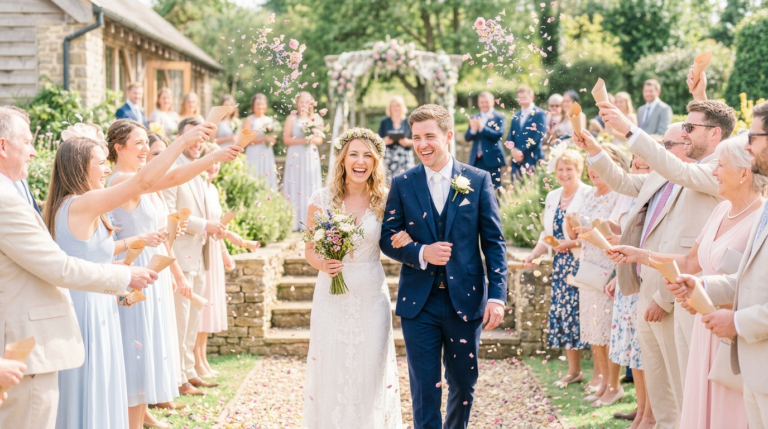
Instead, prepare one small handful per guest in paper cones, simple envelopes or petite fabric pouches that suit your stationery and tablescape. Place them on chairs before the ceremony, hand them out as guests leave, or ask your planner to arrange a quiet line outside the ceremony space. One modest portion creates more movement than people expect, especially when everyone throws at once.
Your photographer can guide the timing. The most natural images often happen when you and your partner walk slowly through the line, looking at each other rather than directly at the camera. Ask guests to throw upwards and slightly forwards, never into your faces. A second walk through can be worthwhile if you want a more playful image, but the first should still feel like a real release of joy rather than a production.
For destination weddings, assign this task to a trusted planner, venue coordinator or one organised member of the wedding party. You should not be thinking about bags of petals while you are taking in the first minutes of married life.
Let the palette support the wider story
Confetti looks most considered when it echoes the wider atmosphere without becoming overly coordinated. At a sun-washed Provençal celebration, faded blue and ivory petals may reflect the linen, stone and sky. For a London winter wedding, a restrained wash of white petals against dark tailoring can feel polished and cinematic. A lake-side celebration might call for pale blush and soft green, chosen for how they sit against the landscape rather than for a trend-led colour formula.
Scale is equally influential. If your ceremony is framed by dramatic architecture, a generous cloud of pale petals can soften the geometry. In a smaller garden, a gentler scattering preserves the intimacy. This is where sustainable wedding confetti becomes part of the design language: it should enhance the scene, not compete with it.
Consider your attire, too. Dark suits and bold bridal party colours can carry brighter petals beautifully. With a silk gown, a long veil or intricate tailoring, lighter petals often look more graceful and are less likely to distract from the silhouettes you have chosen so carefully.
Thoughtful alternatives when confetti is not allowed
A venue’s no-confetti policy does not mean losing the celebratory exit. Ribbon wands create movement without leaving anything behind, especially in an open garden or beside the sea. Bubble wands can be enchanting for a relaxed daytime celebration, although they work best with good light and a clear plan for any slippery residue.
For evening receptions, sparklers can offer a warm, theatrical alternative where permitted and safely managed. Guests can also gather for a champagne toast on the steps, or greet you with a wave of linen napkins on the dance floor. The feeling comes from collective participation, not from a material falling through the air.
The most memorable weddings are attentive to their surroundings as well as their aesthetics. Choose the gesture that lets your guests celebrate freely, then leave the setting just as beautiful for the next love story to arrive.